Control P2P through plugin parameters
Through the panel it's possible to precisely set up the QUANTEEC plugin options for all the SDKs or for a specific SDK (Web, Android or iOS). These parameters can be set up for all the videos, for a specific configuration or for a specific video.
Activate or deactivate P2P
Through the QUANTEEC panel it is possible to enable or disable P2P for all or a subset of streams and for one or more SDKs (Web, Android, iOS).

Be careful before deactivating the QUANTEEC plugin. In the case of a large number of viewers, your CDN can be overloaded. For the QUANTEEC web SDK, if a problem occurs during a stream, please try our sample tool to check if the problem is related to QUANTEEC, the stream, or the web player.
Activate P2P according to the number of viewers
It's possible to set up a minimal number of users before activating P2P for a stream. With this option activated, the P2P will only be activated when a video is watched by a sufficient number of viewers.

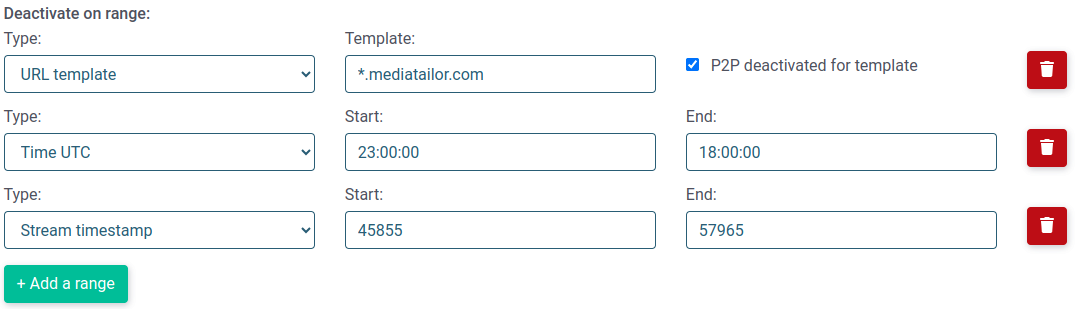
Activate P2P on specific ranges
P2P requests can be enabled or disabled on a per-range basis by specifying time-ranges (in UTC), stream timestamps, or specific video segment urls.
Activate P2P on a percentage of devices
P2P requests can be enabled only on a defined percentage of devices, globally or for each SDK.

Control P2P upload on cellular network
In order to save the data of the viewers on cellular devices, it's possible to completely deactivate the P2P upload request on cellular networks. Therefore, the devices of the viewers are only able to download data through P2P and HTTP but are not able to send data through P2P.

Control P2P upload bandwidth
It is also possible to limit upload bandwidth from viewers' terminals (through a percentage of their estimated upload capacity).

Enable advanced logs for one session
To investigate one connected viewer, call the control API on the controller hosting that peer:
curl -X POST 'https://<controller>:6060/peer_logs?peerID=<peer-uuid>' \
  -H 'Authorization: Bearer <health-check-token>'
This sends useSendLogs: true and forceLogLevel: 3 (DEBUG) through the existing
WebSocket, supported by the Web and Android SDKs. Logs are written to
/controller/logs/{day}/{client}/{videoID}/{peer}.jsonl on that controller.
Manual activation overrides sampling and session-issue log settings until the
peer disconnects, and is additional to the automatic sampling quota. It is not
saved or reapplied on reconnection. A successful response confirms the parameters
were sent, without SDK acknowledgement. An unknown or disconnected peer returns
404; a peer not yet ready or a WebSocket write failure returns 502.
Collect logs from a limited set of sessions
The controller control API supports a log-sampling policy per client, per
controller: PUT /log_sampling/{client} with enabled, maxPeers (20 by
default), mode (random or lowP2P), and logLevel (3 / DEBUG by default).
Controllers are independent; configure each controller where logging is required.
Settings are saved locally and survive controller restarts. This is a control API
feature, not currently a Panel UI option.
Both modes draw randomly from concurrent sessions and replace disconnected or
ineligible sessions. lowP2P additionally requires positive P2P download below
maxDownloadP2PPercent and upload below maxUploadP2PPercent (both default to 20).
Percentages compare the latest analytics interval's P2P download or upload with
total download. Zero P2P download, disabled/unready P2P, missing/stale metrics and
heavy seeders are excluded. Zero upload is allowed. Fewer sessions may be selected
if too few qualify or while a replacement is being enabled.
Only selected sessions receive log-activation parameters. Sampling takes
precedence over other controller log-activation settings for this configured
client, including when the sampling policy is disabled, except for manual
activation through /peer_logs. Manually activated peers appear in the selected
list in addition to the automatic quota. Selected disconnections
request replacement immediately; eligibility is also rechecked every ten seconds.
The existing Web and Android params keys are used. The Web tracker clears a
previous logging override when the next session's initial parameters omit it.
Refer to the controller's HTTP API reference for authentication and full settings.
Version rules for legacy Android SDKs
Android SDKs before 1.9.2 report their SDK version in analytics (data.v) rather
than in the WebSocket init message. When a matching controller version policy
allows versions older than 1.9.2, the controller keeps a legacy Android connection
open until the first nonempty analytics version arrives. P2P groups are blocked
while a matching nonempty version access policy is waiting for that version.
The controller then evaluates the original version policies: authorization
closes a connection whose version is rejected; p2p keeps analytics connected but
denies P2P groups. The latest group request received while waiting for the version is retained per
connection and replayed once when P2P access is approved, allowing Android to
receive its group response without retrying. Earlier requests are replaced; the
pending request is discarded on denial or disconnect. Replay uses the normal
group checks. An admitted version can join groups,
subject to existing configuration rules. Version-specific parameters are resent.
The first version is retained; analytics do not replace a version supplied in init.
This fallback is restricted to legacy Android rules. A minimum version of 1.9.2
or newer still requires a version in init; missing required versions are rejected
immediately. Web and other SDKs retain their existing admission behavior. For
example, Android thresholds of 1.8.35 and 1.9.0 support the analytics fallback,
whereas a Web threshold of 1.4.2 does not. Thresholds and exact lists still
normalize the _Android suffix. Configure these policies in the controller's
security/datainjecters.json, and reload the file through its authenticated
POST /injecters/reload endpoint to reconnect affected viewers.
FPT IPv4 group placement experiment
For client fpt only, when collected ICE candidates (candidateAddrs) are
nonempty and all IPv4, the controller prefers eligible groups by the highest
proportion of peers on other known ISPs, then in other known cities, then group
size. The requesting peer is excluded. A difference counts only when both the
requesting peer and the member have known ISP/city values. If neither proportion
is positive, normal ranking applies.
This preference precedes same-ISP, city and region preferences and disables
forced same-ISP filtering in this case. Previous-group and same-public-IP
priorities, quality, capacity, segment-range and eCDN rules remain unchanged.
Empty candidate lists or any IPv6 candidate retain normal placement.
Candidates are collected during signalling, so the preference applies to later
group requests once IPv4 candidates are known; it does not move existing peers
on its own. The controller records different_isp_ipv4 when ISP diversity wins,
or different_city_ipv4 when only city diversity wins.
No SDK configuration is required. Other clients retain normal placement.